The Short Answer on Cabinet Refinishing
Cabinet refinishing keeps your existing doors and changes their colour. It costs roughly $2,000 to $4,500 for a Columbus kitchen, about half of a cabinet reface, and it only works on solid wood or wood-veneer doors that are still structurally sound. If your doors are thermofoil or laminate, or if you dislike their shape rather than their colour, refinishing is the wrong product and new doors are the right one.
What Refinishing a Cabinet Actually Involves
Almost all of the value in a cabinet refinishing job is in the preparation, and almost all of the failures come from skipping it.
- Degrease. Kitchen cabinet doors carry years of aerosolised cooking oil, heaviest above the range and around the handles. No coating bonds through grease. This step is boring, unglamorous, and the difference between a five-year finish and a five-month one.
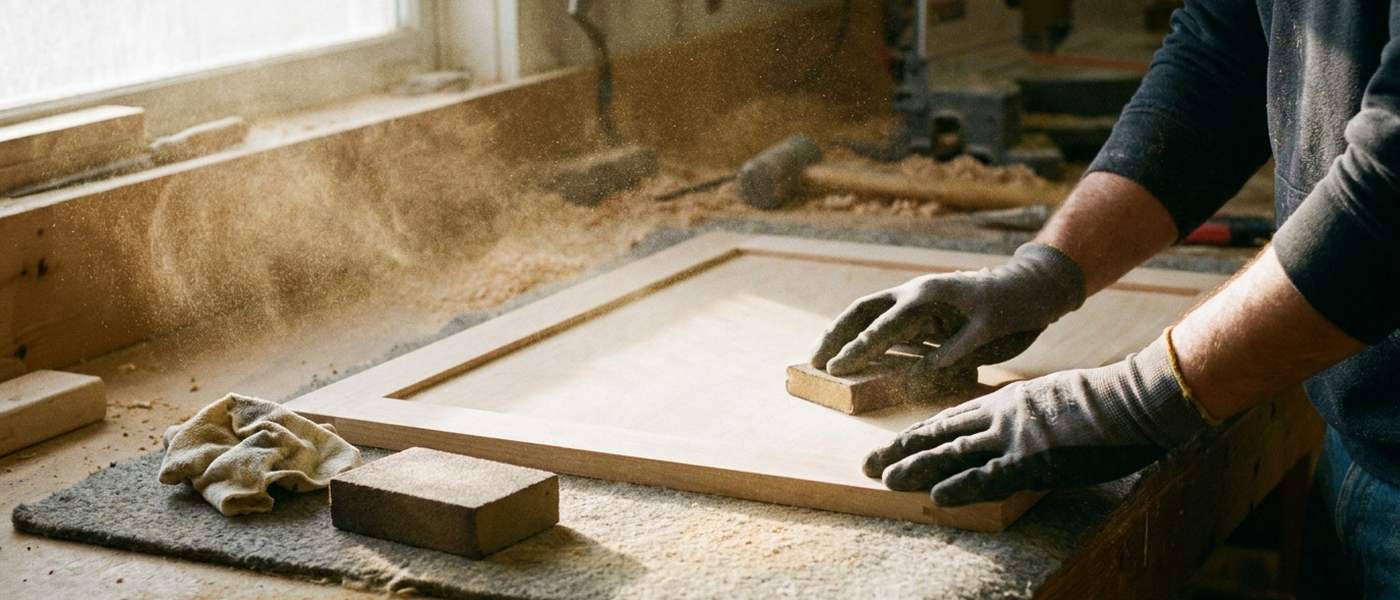
- Sand and de-gloss. The existing finish is knocked back to give the new coating something mechanical to key into. Doors come off and are done flat; face frames are done in place.
- Fill and repair. Dents, chipped cabinet edges and old hardware holes get filled if the hardware is changing.
- Prime. A bonding primer, tinted toward the topcoat, especially where a dark stained cabinet is going light.
- Spray the topcoats. Two or three thin sprayed coats of a catalysed or conversion finish, cured between coats. Sprayed and cured is what makes a refinished cabinet door feel like a factory finish instead of a painted one.
Which Cabinets Can Be Refinished at All
Two things decide it, and you can check both yourself. The first is what the cabinet door is made of: solid wood and real wood veneer take a finish, and thermofoil and laminate do not. Look at the edge of a door, because a wrapped vinyl skin is obvious at the corner where it starts to lift. The second is whether the cabinet boxes and face frames are sound, since a refinish coats them in place and cannot correct a box that has gone soft.
If both answers are good, cabinet refinishing is the cheapest real change you can make to a kitchen. If either is bad, the money is better spent on new cabinet doors.
When Refinishing Will Not Work
Being straight about this costs work and saves everybody money.
- Thermofoil and laminate doors. A vinyl skin or a printed sheet over MDF. Paint does not adhere durably and a lifting corner cannot be re-bonded. These kitchens need new cabinet doors.
- Water-damaged cabinet doors. A swollen bottom rail on a sink-base cabinet door is structural, not cosmetic.
- Heavy grain you want gone. Open-grain oak painted white still reads as oak, because the grain telegraphs through. It can be grain-filled, but by the time you have paid for that on twenty-five doors you are close to the cost of new ones.
- A cabinet door style you dislike. Refinishing cannot change a shape. If the cathedral arch on your 1985 cabinet doors is the thing bothering you, no colour fixes it and new cabinet doors are the honest answer.
Grease, Humidity and Why Columbus Cabinets Are Hard on Finishes
Two local conditions work against a cabinet finish here. The first is humidity: with roughly 49 to 51 inches of rain a year and a genuinely humid June through August, a coating cured in an unconditioned space takes longer to harden and stays soft enough to mark for longer. The second is that the kitchens are old. In a city where 64.8% of the housing stock predates 1980, a cabinet door has usually been painted or coated at least once already, and the new finish is only as good as the layer underneath it.
One more question worth asking, and it is specific to older Columbus houses. Roughly 59,614 homes here — 64.8% of the housing stock — were built before 1980, which straddles the 1978 cutoff the federal lead-paint rules use. Sanding old painted cabinet doors in a pre-1978 house is exactly the kind of work those rules cover. Ask whether the firm doing the sanding is an EPA Lead-Safe Certified firm and how they plan to contain the dust. This site holds no certification of any kind and is not telling you it does — it is telling you what to ask the person who shows up.
Cabinet Refinishing, Painting and What You Should Be Quoted
Whole-kitchen refinishing in Columbus runs roughly $2,000 to $4,500. Priced per door instead, expect $70 to $125 per door and drawer front, rising toward $250 where a dark stain is going white or the prep is heavy. Compare that against cabinet refacing at $4,000 to $10,000 and replacement at $12,000 and up, and the decision usually makes itself once you know which product your doors can actually take.
Cabinet refacing is dispatched across the consolidated Columbus–Muscogee County area and out into the Chattahoochee Valley: Columbus, Fort Benning, Fortson, Midland, Upatoi, Cataula, Ellerslie, Hamilton, Waverly Hall and Pine Mountain in Georgia, plus Phenix City and Smiths Station across the river in Alabama. Columbus and Muscogee County are the same government — Georgia's first consolidated city-county, merged in 1971 — so “city” here means the whole county: 203,711 people and 92,031 housing units, inside a metro area of 325,615. The cabinet work does not change when you cross the state line at the Chattahoochee; the drive time does, so say where you are when you call.